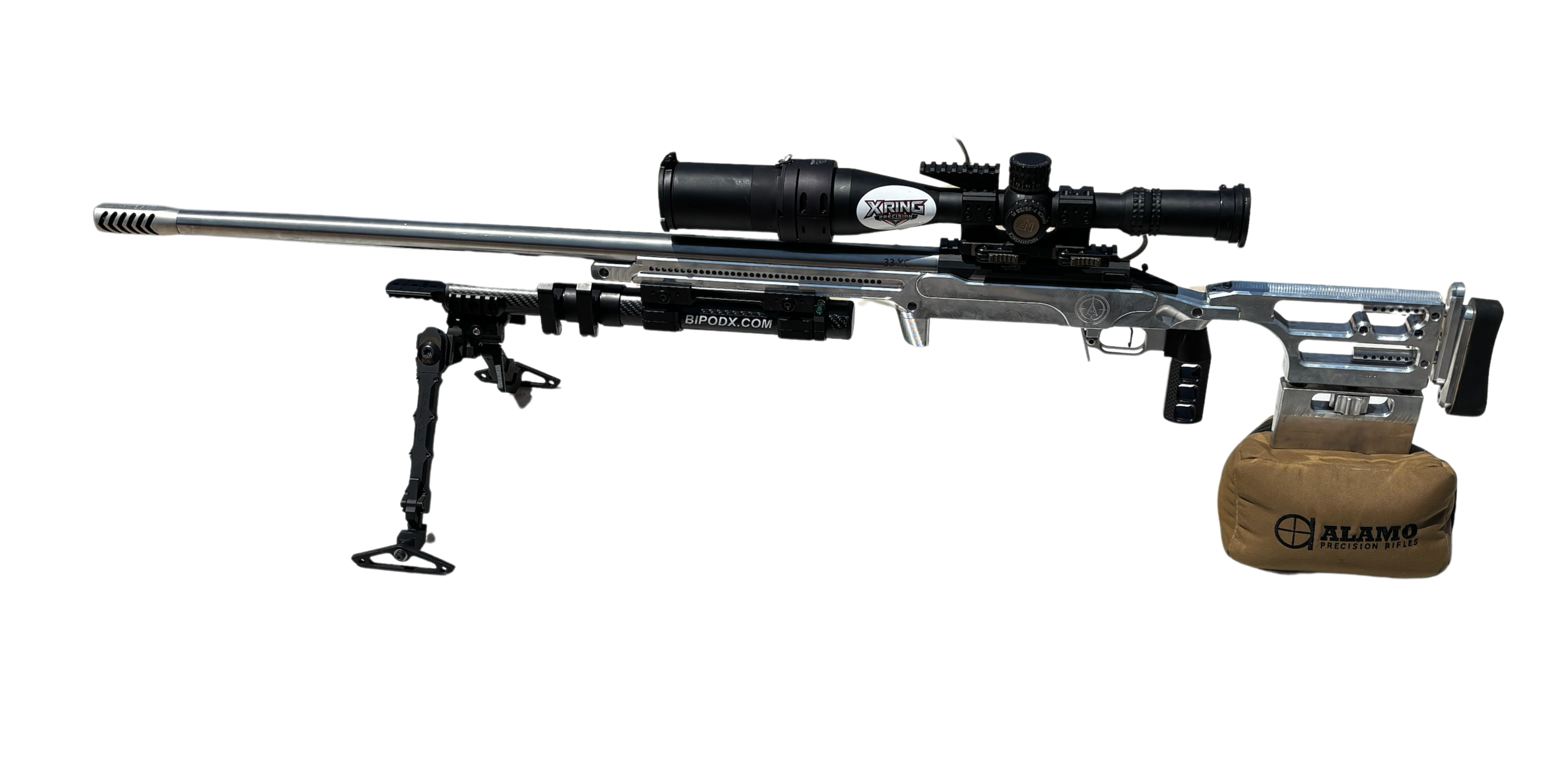
A rifle that groups well at 100 yards and stops hitting at distance is not usually a broken rifle. It is usually a setup that has quietly run out of something — elevation, consistency, or information. The frustrating part is that nothing announces it. You just miss, and then you start working backward through the ammo, the wind call, and eventually the barrel.
Most of the time, the answer is simpler than the search. That's what this blog is for.
I'm Newt. I'm a precision specialist at X-Ring Precision in Wichita Falls, Texas, and I've spent decades on the shooting, testing, and machining side of this — long enough to know which problems are complicated and which ones only look that way. This is where I write down what we find at the bench.
How I approach it

Precision starts with understanding. You can buy good gear and still get beaten by a setup problem, because the equipment was never the limiting factor. So before I recommend anything, I'd rather explain what's actually happening — the geometry, the numbers, the trade-off — and let you decide what your rifle needs.
You're the one behind the rifle. My job is to hand you the information in a form you can use, not to tell you what to think about your own setup.
Newt's Tip — Measure twice. Shoot once. Almost everything I've learned the hard way traces back to skipping the first half of that.
How every post here works
Same structure every time, so you can skim it or read it properly and land in the same place:
- The problem. The specific thing that goes wrong, described the way it actually shows up on range day.
- The fix. What solves it — the part, the process, or an honest "nothing we sell will help you here."
- The result. What changes afterward. More usable elevation, a cleaner bench, fewer surprises, or a decision you don't have to revisit.
No buildup, no twelve paragraphs before the point. If a post can be short, it will be short.
What we'll get into
- Optics and mounting. Turret travel, scope bells, prisms, and rails — including why a "56 mm scope" tells you very little about what will actually clamp onto it.
- Long range and ballistics. Drop, solvers, truing your dope, and the difference between data that looks right and data that holds up at distance.
- Reloading. Loading blocks, funnels and adapters, case organization. The unglamorous half of the process, which is also the half that prevents mistakes.
- Maintenance and tools. Bolt work, torque, mounting room, and the difference between "almost enough rail" and enough rail.
- Precision gear and value. What equipment really costs once you add the mount, the case, and the bench time. The sticker price is the starting figure, not the total.
- Product testing and industry notes. What we measured, what surprised us, and what we're still working on.
- Suppressors. Sound signature, caliber matching, and choosing sensibly for eligible customers under applicable law.
Suppressors are regulated products. Availability, ownership, transfer, and use depend on applicable federal, state, and local law. Nothing here is legal advice — confirm your own eligibility and requirements before purchase.
What I won't do

Worth stating plainly in the first post, because it's the reason to keep reading the rest.
- I won't overpromise. No product makes a rifle shoot better than it's capable of shooting. Some products let you use the accuracy you already built. That's a real claim, and a different one.
- I won't run down other manufacturers. Where we compare, we compare on published numbers and arithmetic you can check yourself. If another company's product is the better answer for your setup, the math will say so, and so will I.
- I won't talk down to anyone. Everyone started somewhere. Nobody is born knowing what a mount adapter costs.
- I won't be casual about safety. Not with handling, not with regulated products, and not for the sake of a joke.
The target doesn't care about opinions. It only responds to what's true, which is a useful standard for a blog as well as a range session.
Where to start
If you're running out of elevation before you run out of confidence, start with the optics and mounting posts — that's the most common problem we hear about, and the one with the clearest fix. If the bench is what's slowing you down, start with the reloading notes. If you're comparing gear, the value posts are where the arithmetic gets interesting.
And if what's bugging you isn't written up yet, tell us. A good portion of what ends up here started as someone's email.
Newt's Tip — Good gear helps. Proper setup wins. If you only have budget for one of them this year, spend it on the setup.
First problem, first fix.

NEWT
Precision Specialist · X-Ring Precision
Practical precision-shooting notes from the bench — optics, elevation, reloading, and gear that holds up when you measure it.